In This Article
- 01He Retired From Corporate Life. Then He Built a Business for the Greater Good.
- 02The Retirement Advice That Inspired a Small Business Founder
- 03A Business Built for the Greater Good
- 04The Hidden Challenges Every New Founder Faces
- 05Becoming the Person Who Has to Do Everything
- 06Why Administrative Work Slows Down Small Business Owners
- 07Leadership Lessons for Small Business Owners
- 08The Goal Is 50
- 09Growth Requires Becoming Someone New
- 10The Hidden Side of Entrepreneurship
- 11Every Founder Has a Story
- 12If You're Ready to Stop Doing Everything Yourself
Key Takeaways
- A single piece of timely financial advice at age 23 shaped Charles' entire retirement — now he wants to give that same opportunity to others.
- FTG Squared donates 5% of revenue to a nonprofit rebuilding Baltimore neighborhoods while keeping longtime residents in place.
- The biggest challenge wasn't mastering retirement planning — it was becoming responsible for everything else as a solopreneur.
- Leading with love and compassion, not pressure, is Charles' core leadership philosophy.
- His next milestone is 50 clients — helping 500–600 employees build a more secure financial future.
Every founder has a story.
Not just about how they started their business, but about the experiences, values, and decisions that shaped the entrepreneur they became.
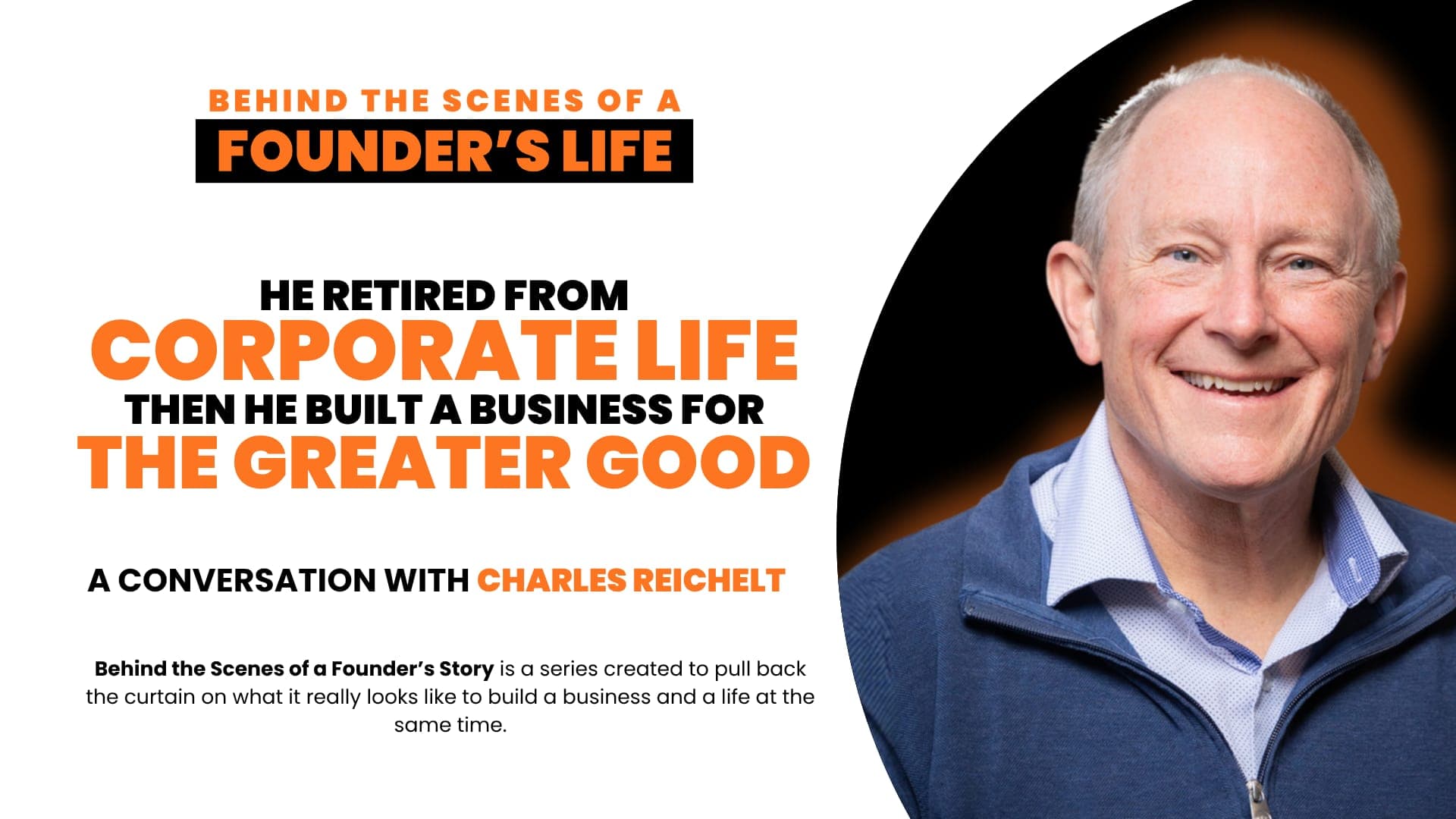
In this edition of Behind the Scenes of a Founder's Life, I sat down with Charles Reichelt, founder of FTG Squared, to talk about his transition from a decades-long corporate career to building a business dedicated to helping small business owners create better retirement plans for their employees.
Like many founder journeys, his story isn't just about entrepreneurship. It's about purpose, service, leadership, and creating something that leaves people better than you found them.
He Retired From Corporate Life. Then He Built a Business for the Greater Good.
I always begin my founder interviews with the same question: "Tell me about yourself."
Charles didn't begin with his career. He began with the people who matter most.
He told me he is a husband, a father of three grown children, a lifelong Maryland resident, a musician, and a runner. He has been married for nearly 30 years, and when his children are away at college, he and his wife make it a priority to visit them every semester, stepping into the lives they are building for themselves.
Only after sharing that did he tell me about his work.
Charles has been in the retirement planning and 401(k) industry since 1990. Over more than three decades, he has worked in administration, relationship management, employee education, and sales, helping more than 4,000 retirement plans along the way.
Eventually, he retired from corporate America. But he wasn't ready to stop serving.
Instead, he founded FTG Squared, a company focused on helping startups and small businesses with up to approximately 50 employees simplify retirement planning and employee benefits.
His goal is simple: to become what he calls the "easy button advisor" for founders and small business owners.
"I don't think it's fair to put an additional burden on them to run a benefit for their employees. I try to take as much of the work off their plate as possible."
His work helps business owners simplify 401(k) administration, reduce taxes, build long-term wealth, improve employee retention, and create stronger employee loyalty. But behind those practical outcomes is something much deeper.
The Retirement Advice That Inspired a Small Business Founder
I asked Charles what inspired him to leave a successful corporate career and start his own business after spending more than 30 years in the same industry.
Many people reach retirement looking forward to slowing down. Charles saw it differently.
"I enjoy passing along good advice to people that I was so fortunate to receive when I was a young person."
When he was only 23 years old, one of his managers made a decision that would shape the rest of his financial life. Rather than asking Charles whether he wanted to contribute to his retirement account, the manager simply told him he was going to contribute a certain amount. There wasn't much discussion.
Charles followed the advice. Looking back, he credits that single decision with putting him on the path toward financial security and retirement.
Today, he wants to give that same opportunity to other business owners and their employees. Many small business owners never receive guidance on creating retirement plans that truly benefit both their company and the people who work for them. That's one of the reasons Charles started FTG Squared — to make retirement planning accessible, practical, and easy for entrepreneurs who already have enough on their plate.
A Business Built for the Greater Good
As our conversation continued, it became clear that Charles wasn't motivated solely by helping companies manage employee benefits. His vision reaches much further.
He wants to help reduce the wealth gap in America by improving financial security one business at a time. His work helps employees prepare for retirement with dignity while helping founders build wealth beyond the value of their businesses.
Then he takes it one step further. Charles donates five percent of FTG Squared's revenue to a nonprofit organization dedicated to rebuilding neighborhoods throughout Baltimore — and what impressed him wasn't simply that the organization restored neglected communities. It was that they did so without forcing longtime residents to leave.
"It's improving the area, but also keeping the people that lived in that area all those years."
Listening to him describe it, I realized how connected everything was. First, he helps someone build wealth through a retirement plan. Then part of that same business supports stronger communities where families can continue living as neighborhoods improve. It truly is for the greater good.
The name FTG Squared isn't simply clever branding — it reflects the entire mission of the business. For Charles, entrepreneurship isn't just about building a profitable company. It's about building a business that creates opportunities, stability, and dignity for everyone it touches.
The Hidden Challenges Every New Founder Faces
One question I always enjoy asking founders is: "What's been the hardest part of building your business?" The answer often has very little to do with the product or service they offer. Instead, it reveals what life as an entrepreneur actually looks like behind the scenes.
For Charles, the biggest challenge wasn't understanding retirement planning. He had spent more than three decades mastering that. The challenge was becoming responsible for everything else.
Becoming the Person Who Has to Do Everything
For years, Charles worked as part of a larger organization. There were departments for marketing, operations, technology, administration, and compliance. Everyone had their role, and he could focus on what he did best.
Starting his own business changed that overnight. Now every responsibility landed on his desk — marketing, sales, operations, paperwork, technology, relationship building, and business development.
"You don't really know what you're doing. At least I didn't know what I was doing. And so you make mistakes."
His first website looked great to him. Friends thought it looked good too. But it didn't generate traffic, and more importantly, it didn't communicate clearly with the small business owners he wanted to serve. He invested time learning SEO. That didn't produce the results he expected either. Then came the endless administrative work — forms, processes, systems, and paperwork that once belonged to someone else were now entirely his responsibility.
He described the experience perfectly: "Two steps forward, one step back." I smiled because I think almost every entrepreneur has lived through that season. You try something. It doesn't work. You learn. You adjust. Then you move forward again.
During our conversation, I joked that entrepreneurship sounds a little like learning the cha-cha. Charles laughed. The comparison felt surprisingly accurate. Progress isn't always linear. Sometimes growth looks like learning from mistakes instead of avoiding them. And that's perfectly okay — every lesson becomes part of the foundation you're building.
Why Administrative Work Slows Down Small Business Owners
One question I like asking entrepreneurs is: "If you could instantly solve one problem in your business today, what would it be?" The answer often reveals where founders spend the most mental energy.
Charles didn't say more clients, more revenue, or more marketing. Instead, he said something many business owners quietly struggle with: efficiency.
He wants to become better at handling the repetitive administrative work that consumes valuable time. The challenge isn't that the work is difficult — it's that every unfamiliar process takes longer than expected. A form gets submitted incorrectly. A process has to be repeated. A task that should take ten minutes ends up taking an hour because it hasn't become second nature yet.
Those moments rarely make it onto social media. But they're part of the founder journey. Many entrepreneurs believe they're falling behind because they aren't productive enough. In reality, they're simply carrying responsibilities they were never trained to handle.
Leadership Lessons for Small Business Owners
Toward the end of our conversation, I asked Charles a question I often ask founders: "What lesson has shaped the way you lead?"
He smiled and warned me that his answer might sound a little corny. Then he said something beautifully simple.
"You have to lead with love."
He wasn't talking about being soft. He was talking about leading with compassion, kindness, and patience — helping people move through fear instead of pushing them with pressure. In today's business world, we often celebrate speed, hustle, and winning at all costs. Charles has intentionally chosen a different path.
His philosophy extends far beyond retirement plans. He wants employees to retire with dignity. He wants business owners to create financial security beyond simply selling their company one day. Because the truth is, selling a business is never guaranteed. Many founders spend decades assuming the business itself will become their retirement plan. Charles wants entrepreneurs to build another layer of financial security alongside the company they're creating.
"If I can leave that kind of a legacy for a business owner, that would be the nirvana for my business."
Listening to him, I realized that his business isn't really about retirement plans. It's about helping people create options. Options create freedom. Freedom creates peace of mind. And perhaps that's one of the greatest gifts any entrepreneur can help someone achieve.
The Goal Is 50
As we wrapped up our conversation, I asked Charles what comes next. Like many entrepreneurs, he didn't respond with an ambitious plan to dominate the industry or scale as quickly as possible. His next milestone is much simpler: fifty clients.
For a solopreneur, he believes that's the right next step. Reaching 50 businesses could mean helping approximately 500 to 600 employees build a more secure financial future through better retirement planning.
After that? He'll pause and reassess. Maybe he'll expand the team. Maybe he'll grow to 100 clients. Maybe the business will evolve in a different direction. For now, the focus is on building something sustainable rather than simply building something bigger.
I appreciated that answer. In a world where entrepreneurs are constantly encouraged to "think bigger," Charles reminded me that sometimes the most strategic goal is simply the next right goal.
Growth Requires Becoming Someone New
Before ending our conversation, I shared a thought that's shaped the way I think about entrepreneurship: the purpose of a goal isn't simply to achieve it — the purpose is to become the kind of person capable of achieving it.
Looking back on Charles' founder journey, that's exactly what happened. He left a corporate career where he understood the systems, knew the processes, and had an entire team supporting him. Then he started over. The website didn't perform the way he hoped. His SEO efforts didn't immediately generate results. Administrative work became more complicated than expected. Every challenge required him to learn something new.
And despite every setback, he kept moving forward.
"Every day is a new day. Every day is a different day."
That mindset may be one of the greatest competitive advantages a founder can have. You don't become an entrepreneur because you already know how to do everything. You become one because you're willing to learn what you don't know.
The Hidden Side of Entrepreneurship
One of the reasons I created Behind the Scenes of a Founder's Life is because social media often shows entrepreneurship as a series of wins. We celebrate revenue milestones, product launches, business acquisitions, and funding announcements.
But behind every successful founder is a quieter story — the uncertainty, the mistakes, the paperwork, the difficult decisions, the learning curve. The moments when progress feels like two steps forward and one step back. Those moments deserve to be talked about too. Because they're part of building a meaningful business.
Charles reminded me that success isn't always about growing faster. Sometimes it's about staying committed to a mission that genuinely improves other people's lives. His business helps entrepreneurs build wealth, helps employees retire with dignity, and supports stronger communities.
And it proves that business can create far more than profit — it can create stability, opportunity, legacy, and, as the name FTG Squared reminds us, it can truly be for the greater good.
Every Founder Has a Story
One of my favorite parts of hosting these conversations is discovering what happens behind the scenes — the lessons, setbacks, and moments of growth that rarely make it into headlines. If you're a founder with a story you'd like to share, I'd love to hear from you. These conversations remind us that entrepreneurship isn't about having all the answers. It's about continuing to learn, adapt, and build something that matters.
If You're Ready to Stop Doing Everything Yourself
One theme keeps coming up in these founder interviews: eventually, every entrepreneur reaches a point where doing everything alone becomes the biggest obstacle to growth. If your challenge is execution, hiring, delegation, or creating more freedom in your business, that's where my team can help.
Connect with Charles Reichelt
Frequently Asked Questions
Who is Charles Reichelt?+
Charles Reichelt is the founder of FTG Squared, a company that helps startups and small businesses simplify retirement planning and employee benefits. He has been in the 401(k) and retirement planning industry since 1990 and has helped more than 4,000 retirement plans over his career.
What does FTG Squared do?+
FTG Squared helps small business owners with up to approximately 50 employees simplify 401(k) administration, reduce taxes, build long-term wealth, and improve employee retention. Charles also donates 5% of revenue to a nonprofit rebuilding Baltimore neighborhoods.
What was Charles Reichelt's biggest challenge as a new founder?+
Despite his deep expertise in retirement planning, Charles' biggest challenge was becoming responsible for every other aspect of running a business — marketing, SEO, operations, administrative work, and technology — all of which were handled by departments in his previous corporate roles.
How can small business owners connect with Charles Reichelt?+
You can connect with Charles on LinkedIn at linkedin.com/in/charlesreichelt or visit his website at ftgsquared.com to learn more about retirement planning solutions for small businesses.