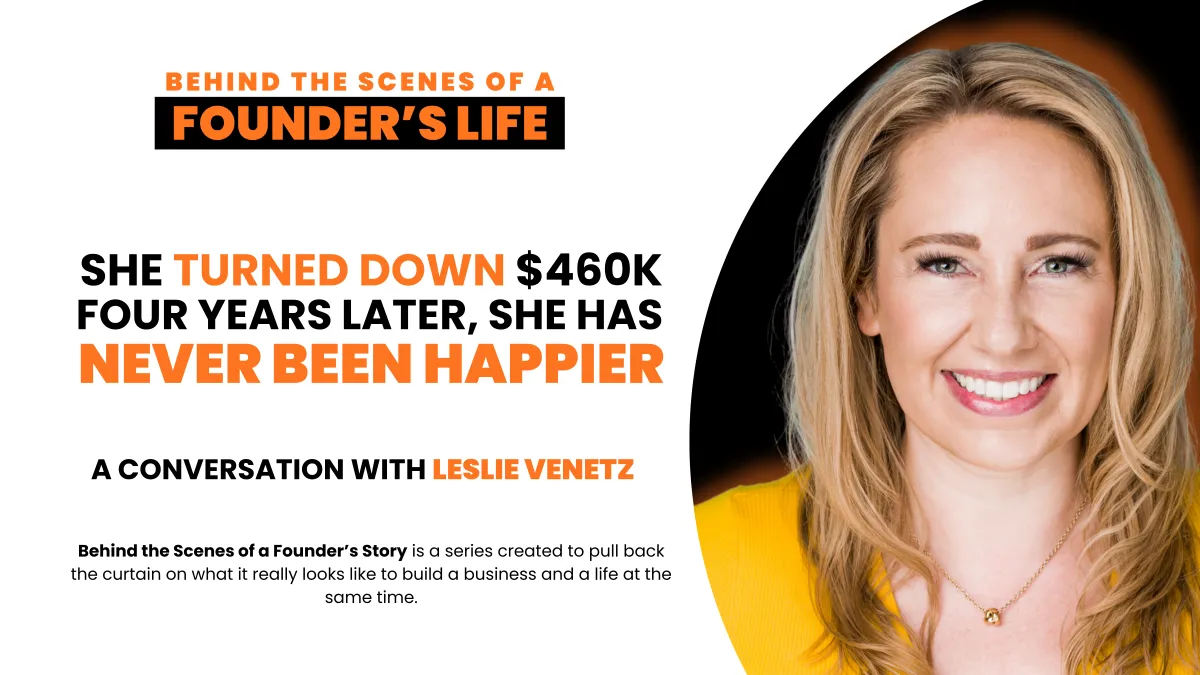
She Turned Down $460K. Four Years Later, She Has Never Been Happier.
Behind the Scenes of a Founder's Life + Leslie Venetz
I asked Leslie Venetz to tell me about herself and her journey as a founder.
She started by telling me about a fear she carried for years that turned out to be one of her greatest strengths.
Leslie Venetz is the founder of The Sales-Led GTM Agency. She has been doing consulting, advisory, and speaking work for the past four years. Before that, she spent 15 years in corporate sales, working her way up from individual contributor to sales leader at large global organizations, and also as employee number one at a bootstrap startup.
She sold everything from $2,000 transactional deals to six-figure enterprise contracts. She sold to small business owners and to C-suite executives at Fortune 500 companies.
For a long time, she thought that breadth was a problem.
"Hiring managers really want somebody who has done this exact thing for 10 years. And I held this doubt, this fear that it was a weakness."
What she found instead, once she made the leap into full-time entrepreneurship, was that it was the opposite. That wide range of experience gave her visibility into how different sales processes, cycles, and products actually work. It made her better at everything she does now.
But the journey to get here was not a straight line.
She Was On Track for CRO by 40
For most of her corporate career, Leslie had one goal. She was going to become a Chief Revenue Officer by the time she turned 40.
She was on track. Getting promotions. Making serious money. Checking every box.
And she was burning out. Repeatedly.
"Externally I was thriving. Internally I was just slowly shriveling and dying."
Then a job offer arrived that forced her to get honest with herself. The package was $460,000. It had the title, the reporting structure, and the scope she had been working toward her entire career.
It also came with 80-hour weeks, every week.
"It checked all of my boxes of what I needed to stay on track to CRO by 40. But I knew what it would cost me."
She turned it down.
Why She Stopped Trying to Get the Job
Around the same time, she was interviewing with a string of Series B startups looking for their first head of sales or CRO. What she found in those rooms stopped her cold.
Founder after founder showed open contempt for the sales profession. They needed a salesperson but seemed disgusted that they had to hire one. One told her he needed someone who would be in before sunrise and leave after sundown.
"It was a moment where I had to ask myself, why are you trying so hard to get a job and make money for founders who don't like you? Who don't respect the profession you have dedicated your life to?"
On top of that, she was encountering sexism in interview after interview. More than 90 percent of startup funding goes to men, predominantly white men. She felt it in every room she walked into.
And she had been quietly building her own agency on the side for a while. Getting referrals. Growing on social media. Getting inbound. The foundation was already there.
So she bet on herself.
Year One Was Not What She Expected
Before diving back in, Leslie did something most people would not give themselves permission to do.
She took three months off.
She used her final bonus check, around $92,000, as her runway. She did not try to relaunch immediately or hit the ground running. She sat with questions she had been too busy to ask.
"What habits serve me? What do I want to carry forward into this new life I'm building? What type of work fills up my cup and is also something people will pay me for?"
She went from a W-2 of over $300,000 to paying herself $50,000 in year one. She cancelled subscriptions. She skipped vacations. She stopped contributing to her 401k to make the runway last.
But the hardest part of year one had nothing to do with any of that.
"It wasn't generating leads or figuring out what products to sell or how to go to market. It was a lot of sneaky things around giving myself grace. And letting myself grieve a little bit."
She had spent 15 years working toward a specific dream. Leaving meant letting go of that dream and the identity that came with it. That grief was real, and it took time to move through.
What Actually Makes the Business Work
I asked her what she believes makes her agency successful four years in.
Her answer was not what I expected.
"I spend a lot of time and money on therapy, on courses, on working out, on my spirituality and my emotional and mental wellbeing. That's a huge part of why my business is so successful. You're seeing all of that reflected back into the world."
The other thing she credits is staying clear on what she actually wanted. From the beginning, her number one metric was freedom. Not scale. Not headcount. Not revenue to the moon.
People pushed back on that. Hard.
"So many people told me the way I wanted to run my company was wrong because they had a different version of what success meant. Luckily I was so confident that solopreneurship was my dream that I was able to acknowledge that maybe their advice was a projection of their own fears."
Today she works with nine to twelve freelancers and outsourced partners, each with specific domain expertise, rather than managing a team of employees. She delivers better work with less stress and more speed because everyone around her is genuinely excellent at what they do.
A USA Today Bestseller and Still Fighting Imposter Syndrome
Last year, Leslie published a book. It debuted at number 50 nationally on USA Today and was the number two business book that week, right behind Mel Robbins.
She is a top one percent content creator on LinkedIn and TikTok. She has been named one of the 70 most influential thought leaders globally in sales and marketing.
And a few weeks before we spoke, imposter syndrome still knocked her flat.
So she did something practical. She sat down and made a list of objective facts.
"40 percent of businesses fail before year three. Going into year four, I'm in the top 50 percent. That's a big deal. What percent of people who publish books make USA Today? It was 0.002 percent. Of those, what percent are women? And it takes a nosedive."
She said the exercise helped her remember that imposter syndrome is often a sign that you are in rooms with truly exceptional people. That the feeling is not evidence of failure. It is evidence of how far she has come.
What Is Next
I asked her what she is working toward right now.
She has a goal she announced with zero hesitation.
"Last year I did 13 paid speaking gigs. My goal this year is to double it. 26 in 2026."
She has already been doing the work to get there. Investing in her presentation and storytelling skills. Getting testimonials and referrals in order. Building decks with more emotional resonance. And of course, writing a bestselling book did not hurt.
She said she is already on pace and genuinely excited about where it is going.
Four years ago she walked away from a $460,000 job offer and a dream she had chased for 15 years.
She told me she is the healthiest and happiest she has ever been in her professional life.
I believe her.
Want to Connect?
You can find Leslie Venetz on LinkedIn, YouTube, Instagram, and most other platforms at Leslie Venetz. For her best unfiltered content, find her on TikTok @salestipstok. Her website with all links is salesledgtm.com.
And if you are a founder with a story behind the scenes, I would love to hear from you too. These conversations remind us that success is rarely a straight line.
And if your challenge is execution, hiring, or freeing yourself from the day-to-day work, that is where we come in.
At Meet 5 Star Pros, we help founders hire high-level remote operators like Online Business Managers, Marketing Project Managers, and Executive Coordinators.
At Smart VAs, we provide dedicated virtual specialists who support marketing, operations, and growth so you can focus on what you do best.
Growth is not just about pushing harder.
It is about having the right people in the right seats.
And if you are a founder who wants to share your own behind-the-scenes story, DM me on LinkedIn.
Your story might be the one someone else needs to read today.
Sometimes growth is not about working harder.
It is about putting the right people in the right seats.
