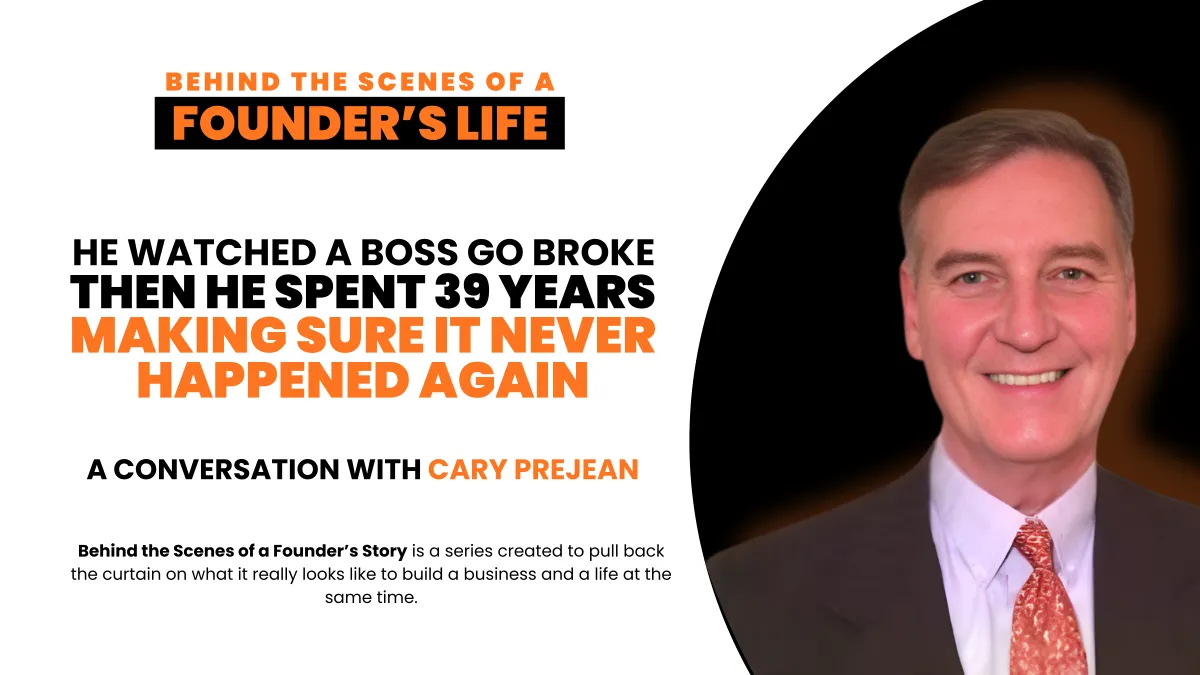
From Boss Going Broke to 39 Years Preventing Failure
Behind the Scenes of a Founder's Life + Troy Hipolito
I asked him to tell me about himself and his journey as a founder.
He started with a story about a business owner who went broke.
Tell me about you and your journey as a founder.
Cary Prejean is a business advisor based in Baton Rouge, Louisiana.
"I help small and medium-sized business owners get control of their numbers, build processes that actually work, and stop doing everything themselves."
He has been doing this since 1987.
That is 39 years.
And when I asked him what he wished he had more of in his business, he said another 40 years.
Not because he has to. Because he loves it that much.
The Boss Who Went Broke
Cary's background is accounting. He studied it, worked for Fortune 500 companies and a big accounting firm, and then got hired away by a client who owned an equipment dealership in New Orleans.
What he found when he walked in the door was a mess.
"He didn't know how to read his financial statements. And he didn't have any current financial data to help him make business decisions."
Cary was 26, 27 years old. He could see the problems clearly. He tried to flag them. But he was speaking accounting, and the business owner was not listening.
The man had built a successful company, and somewhere along the way he got comfortable. He bought a $2 million sailboat he took out three times a year. He hired a full-time employee just to live on the boat and maintain it. He bought a handmade Rolls-Royce. He stopped making sales calls and started taking them from his office instead.
Cary watched it all unravel.
"He went broke. He declared bankruptcy because he had taken on too much debt. The FED discount rate at that time was 21%, which meant he was paying around 27%, 28% on his line of credit. Unless you're just coining money, you're not going to overcome that."
That experience stuck with Cary. And as he moved through other businesses after that, he kept seeing the same pattern.
Business owners who could not read their numbers. Who were always looking back at last month instead of managing this week. Who were flying blind and did not know it.
He decided to do something about it.
Actionable Financial Data
The thing Cary kept seeing was that business owners would finally look at their financial statements on the 15th or 20th of the following month. By then it was too late to do anything about it.
"Nothing you can do about last month. What are you going to do about this month?"
So he built what he calls dashboards. A simple, real-time picture of what is happening in the business right now. Sales last week. Cash projection. Receivables and payables. Inventory. Website traffic. Tax filings. The numbers that actually help you make a decision today, not the ones that tell you what went wrong two months ago.
He gave me an example from one of his e-commerce clients. When they were still building the business, they watched new website visitors closely. The more new traffic, the more new customers. But as the business grew, the goal shifted.
"Now we want to maintain 65% existing customers because the customer base has gotten big enough. Without them, we're not going to grow sales."
That business went from $2.8 million in 2021 to almost $21 million last year. This year they are on track for $26 to $28 million.
"It's because we weren't just looking at the numbers. We were looking at the right numbers."
Why Entrepreneurs Are Their Own Worst Enemy
After years of working with business owners, Cary noticed something. The very traits that make someone a great entrepreneur are often the same traits that hold their business back.
Entrepreneurs are driven, independent, fast-moving, and always chasing the next idea. That energy is what builds a business in the first place.
But it is terrible for running one.
"After they build a business to a certain point, they spend their entire day micromanaging people, running around putting out fires, saving the day. They wind up working 100 hours a week and wonder why their employees just don't get it."
The problem, he said, is that entrepreneurs assume they are the best people to manage the business because they started it. But managing requires a completely different skill set. Patience. Consistency. Process. Rules.
And those are exactly the things most entrepreneurs cannot stand.
"One of the lines I hear consistently from clients is, we love the results you're producing, but we hate all the rules. And I tell them, it's the rules that are giving you the results."
His job is to help them see that. And then to build the systems that let the business run without the owner having to be everywhere at once.
The Biggest Challenge in His Own Business

I asked him what the hardest part of running his own consulting firm has been.
He did not hesitate.
"One of my biggest weaknesses is marketing. I don't like to do it. I'm not that good at it."
So he did what he tells every one of his clients to do. He outsourced it.
He went through several agencies before finding the right ones. It cost money and it took time. But he said that process of finding the right people is part of it.
He also gave me a piece of advice he gives every business owner who reaches a certain size: outsource payroll. The good payroll companies handle everything, the deposits, the tax filings, the reports. The risk moves to them if something goes wrong. And the cost is minimal compared to the headache it removes.
It is the same principle he applies to everything. If it is not your strength, either build that strength inside your organization or find someone outside who has it.
The Lesson That Took the Longest to Learn
I asked him what lessons have shaped how he operates today.
He said one word first.
"Listen more. Big time, listen more. And don't be so quick to give the answers."
He has been doing this for nearly four decades. When a client describes a problem, he usually knows the answer before they finish the sentence. He has seen it hundreds of times.
But he learned that giving the answer right away does not work. The client feels like you did not really hear them. Like you jumped to a conclusion.
So now he asks more questions. He lets them talk through it. He helps them arrive at the answer themselves.
"It's asking questions, especially about what you don't know, that you begin to think and look for answers you hadn't seen before. And it allows them to see value in what I've said."
He said slowing down made him a better advisor. Not because he knows less. Because the client trusts the answer more when they feel like they were part of finding it.
What He Wants Founders to Know
I asked him what advice he would leave for founders.
He talked about happiness. And then he went somewhere more interesting.
"Happy comes and goes all day. Who cares? As Americans, we tend to be addicted to happy, like it's something out there that we hope to find someday."
What he works on instead, with clients and with himself, is satisfaction. Knowing specifically what you want. Writing it down in detail. Pursuing it with intention.
He got this from a mentor about 40 years ago, and he has never forgotten it.
"The secret to life is getting exactly what you want. Being ultimately satisfied. You've got to know what's going to ultimately satisfy you. And most people have no clue."
Most people spend five minutes thinking about what would make them happy. They never get specific. They never write it down. They never commit to a definition.
And without a definition, they can never actually get there.
"Until you declare satisfaction, you will never be satisfied."
He said satisfaction is a much richer experience than happiness. Happiness is someone making the coffee before you wake up. Satisfaction is building something that means something. Knowing what it looks like. Going after it on purpose.
And then he told me he started his consulting business in 1987.
Thirty-nine years ago.
And when I asked him what he wished he had more of, he did not say money or clients or a bigger team.
He said another 40 years.
I think that says everything.
Want to Connect?
You can find Cary Prejean on LinkedIn and at strategicbusinessadvisors.org or strategicbusinessadvisors.us. He also recommends the book Language and the Pursuit of Happiness by Chalmers Brothers, available on Amazon and at chalmersbrothers.com.
And if you are a founder with a story behind the scenes, I would love to hear from you too. These conversations remind us that success is rarely a straight line.
And if your challenge is execution, hiring, or freeing yourself from the day-to-day work, that is where we come in.
At Meet 5 Star Pros, we help founders hire high-level remote operators like Online Business Managers, Marketing Project Managers, and Executive Coordinators.
At Smart VAs, we provide dedicated virtual specialists who support marketing, operations, and growth so you can focus on what you do best.
Growth is not just about pushing harder.
It is about having the right people in the right seats.
And if you are a founder who wants to share your own behind-the-scenes story, DM me on LinkedIn.
Your story might be the one someone else needs to read today.
Sometimes growth is not about working harder.
It is about putting the right people in the right seats.
