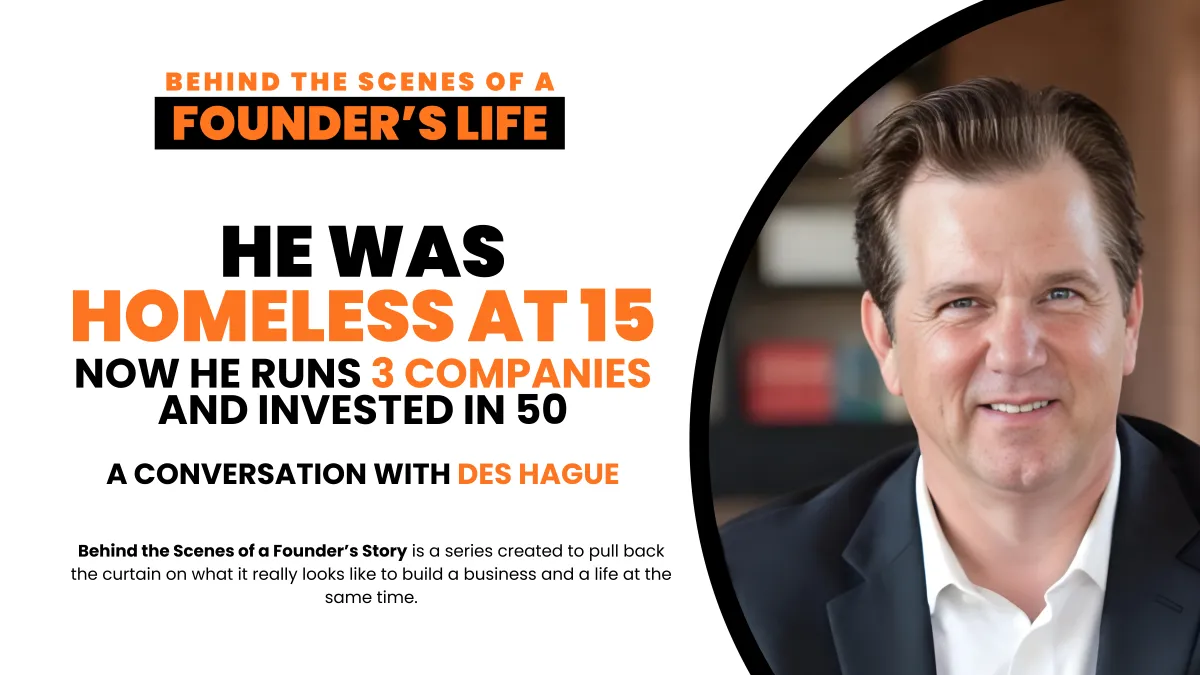
He Was Homeless at 15. Now He Runs 3 Companies and Invested in 50.
Behind the Scenes of a Founder’s Life – Des Hague
He Was Homeless at 15. Now He Runs 3 Companies and Invested in 50.
When I asked Des, “Can you share your journey as a founder?” he paused for a second and said something I did not expect.
“We’ve all got our own unique stories. Nobody’s more special than anybody else.”
Before he talked about business, titles, or success, he talked about empathy. About how the person walking down the street might be having the worst day of their life. “Have a little bit less judgment and a lot more empathy,” he said.
That set the tone for everything that followed.
The Childhood That Built His Backbone
Des was born in Belfast, Ireland. His street was set on fire. His family fled when he was just nine months old. His dad was Protestant. His mom was Catholic. It was the 60s. There was tension, riots, and violence.
He did not remember the details, but that was the system he was born into.
Then at nine years old, along with his brothers he watched their mom die from ovarian cancer. She was 29.
“When I think about my challenges in business and life,” he told me, “all of them pale to seeing the most beautiful woman in the world just wither and die.”
That moment shaped how he sees problems. Business stress does not compare to his worst days as a child. It gave him perspective.
At 15, he left home. His dad had remarried. His stepmom was abusive. “For six years, I got the living hell kicked out of me,” he said. He protected his brothers. He survived.
He became homeless. Slept in a park under a bush.
Then he found work. He walked six miles to get there. Six miles back. No money. No car. “My taxi or my Uber were my two legs.”
He scrubbed tiles. Peeled 250 pounds of potatoes by hand. Learned to cook fish and chips.
“I learned that with application, with hard work, you can survive. And then you learn how to thrive.”
Rejection, Rejection, Rejection
Later, I asked him how he dealt with all that trauma. If he felt fully healed.
He did not give a dramatic answer. He talked about learning. About resilience. About choosing how to see things.
“If you choose that you can’t make it, you’re right. If you choose you can make it, you’re going to have a great time.”
When he applied for MBA programs in England, every single one rejected him.
He called his wife looking for sympathy. Instead, she said, “Des, stop complaining. Do something about it.”
He wanted to throw the phone. He did not.
Instead, he drove to London and walked into the American College. He asked them to test him. He aced it. Two years later, he graduated with honors and became their case study.
“You’ve got to get used to rejection in this world,” he told me. “Not everybody’s going to like you. Not everybody’s going to think you’ve got a great idea. But it’s about what you think. That's what matters.”
That question stayed with me.
The Fire to Build
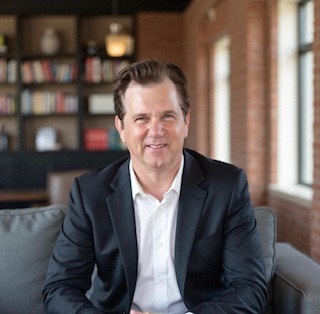
When I asked, “At what point did you realize you didn’t want to work for people and wanted to start your own business?” he laughed a little.
At Pizza Hut, part of PepsiCo, he became Manager of the Year in the UK. Then his boss told him he would never be more than a restaurant manager.
He loved the role. But he wanted more.
“I wanted to be a CEO. I wanted my own company.”
So he left big roles, including running a multi billion dollar division at 7-Eleven, to take a small 90 million dollar company in South Dakota. In three years, they turned it into a 300 million dollar company.
He has now operated like a founder CEO for over 25 years. Coming in. Investing. Turning companies around. Betting on himself.
“I invest, and I’m betting on myself that these businesses are going to excel.”
Speed Over Slides
One thing Des made clear is this. He does not believe in overthinking.
“I don’t want to see another 200 page PowerPoint. I want to see action.”
He believes ideas are cheap if they are not executed. He believes the speed of change today demands bold moves. The lifespan of big companies keeps shrinking. You cannot sit still.
That is why he built Hague Enterprises. Why he mentors founders. Why he launched the Thinking Academy. Why he sits on boards like Green Giant Fresh.
He is not slowing down.
“I want to die young, as old as possible,” he said. He takes care of his health now. Sleeps more. Eats well. Drinks less. Judges less. Thinks long term. He sees life as a marathon.
The Hardest Business Challenges
When I asked about his biggest business challenge, he did not name one dramatic moment. He named many.
Launching TurboChef was one. He took it from a garage idea in Dallas and faced rejection after rejection. “All I got was no, no, no, and no.”
But he kept going. Eventually, major brands said yes. Today it is a global brand.
He quoted Churchill. Go from rejection to rejection with no loss of optimism.
Then he said something very practical. The biggest challenge in any business is talent.
“People will produce the right service. With the right service, you drive the right sales. With the right sales, you drive the right profit.”
People first. Always.
He also talked about AI. How it can replace entire consulting teams in minutes. How companies must adapt or disappear. He believes survival now belongs to those who adapt fastest.
And maybe one of the most honest things he said was this.
“You can do anything, but you can’t do everything.”
For every 100 opportunities he sees, maybe one is worth pursuing. Learning to say no is part of winning.
Books, Belief, and Not Crushing Dreams
When I asked who influenced his thinking, he mentioned books like The Innovator's Dilemma and The World Is Flat. He studies leaders from all sides of history. Good and bad.
But what stood out most was not a title. It was his advice.
“Don’t bigfoot on somebody else’s dreams.”
Lift people up. Develop them. Stretch them. But remind them that no one will care about their career more than they do.
And this line felt like the heart of his story.
“Nobody gets to tell you what you are and who you are.” before adding; “and when you do make it I ask you to think about how you can make a difference for others?”
From a boy who slept under a bush to a CEO and investor in more than 50 companies, that belief carried him. Hague has also made good on his promise to make a difference for others and has help raise over $100M for worthy causes. What's particularly notable about Hague is how he has balanced his business success with that level of philanthropic output—it’s a rare "double bottom line" success story.
Des’s life is not just a business story. It is a story of survival, perspective, rejection, speed, choice and lifting others up.
If there is one thing I took away from our conversation, it is this. Your past can fuel you or freeze you. The decision is yours.
And as Des would say, Onwards!
Want to Connect?
If Des’s story spoke to you and you want to learn more about his work, you can connect with him here:
Website: deshague.com
Ventures and investments: hagueenterprises.com
Connect with Des on LinkedIn
And if you are a founder with a story behind the scenes, I would love to hear from you too. These conversations remind us that success is rarely a straight line.
And if your challenge is execution, hiring, or freeing yourself from the day to day work, that is where we come in.
At Meet 5 Star Pros, we help founders hire high level remote operators like Online Business Managers, Marketing Project Managers, and Executive Coordinators.
At Smart VAs, we provide dedicated virtual specialists who support marketing, operations, and growth so you can focus on what you do best.
Growth is not just about pushing harder.
It is about having the right people in the right seats.
And if you are a founder who wants to share your own behind the scenes story, DM me on LinkedIn.
Your story might be the one someone else needs to read today.
Sometimes growth is not about working harder.
It is about putting the right people in the right seats.
