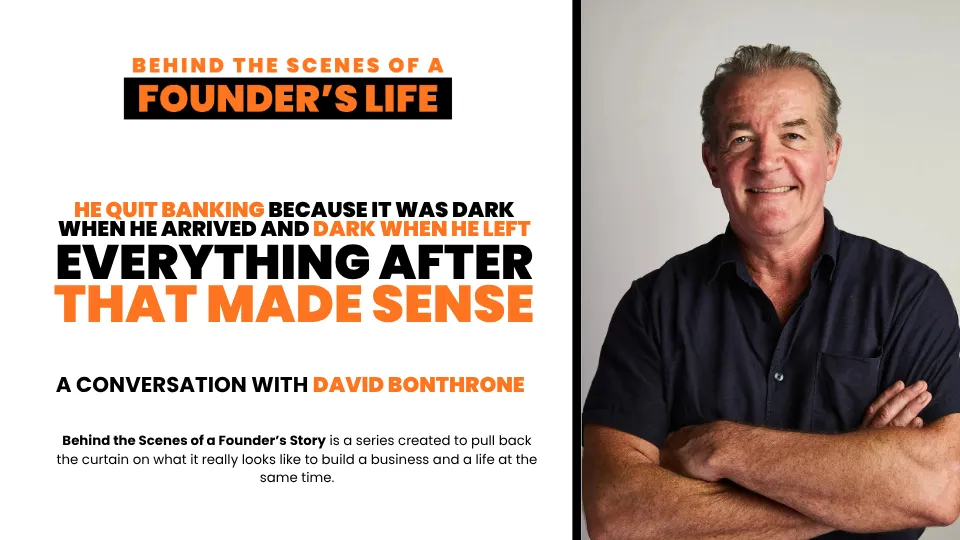
He Quit Banking Because It Was Dark When He Arrived and Dark When He Left. Everything After That Made Sense.
Behind the Scenes of a Founder's Life + David Bonthrone
I asked David Bonthrone to tell me about himself and his journey as a founder.
He started with a pandemic, a closed border, and a mortgage in Manhattan.
David Bonthrone is a fractional and interim Chief Revenue Officer based in New York. His business, Mr. Foster, is built around one simple idea. He fosters relationships. He is, as he puts it, a new business gun for hire.
What makes David especially effective in that role is not just his experience, but the life he has lived around it. He is exceptionally well networked, very well traveled, and multilingual, which has helped him build relationships and navigate business opportunities across different countries and cultures throughout his career.
And if you want one personal detail that says a lot about the kind of person he is, David also happens to be the holder of what he proudly calls the world's most creative marriage proposal.
But the journey to get there took him from London to Australia to New York, through some of the biggest advertising agencies in the world, and eventually into business for himself at a moment when nobody planned for anything.
COVID Closed the Door He Was Walking Through
Just before the pandemic, David was working between the United States and China on something significant. They had just completed the largest celebrity endorsement deal ever done in China. The pipeline was full. Chinese brands wanted to align with Western celebrities and the business had real momentum.
Then COVID hit. China's zero tolerance policy meant no celebrities were going anywhere near it. The pipeline dried up overnight.
So David started looking for a job. He was in New York City, over 50, and the job market at that particular moment was not kind to people who looked like him.
"There were very few jobs that folks like myself were ever going to land. Background to that, wife, two children, mortgage, Manhattan. Not cheap."
But something unexpected happened while he was looking. People kept asking him for help. Can you do a day a week for four months? Can you work for me for the next 16 days? Small requests, but they kept coming.
He started stringing them together. At the end of the first month, the number surprised him. At the end of a quarter, it surprised him more. At the end of the year, he looked at what he had built almost by accident and thought, hang on.
Six years later, he is still at it.
"I'm still delusional enough to be working for myself. But it's been great."
From Bond Salesman to Ad Man to Gun for Hire
David's career did not start in advertising. It started in banking in London, where he was a bond salesman.
He was earning well. His colleagues were impressed. And he was miserable.
"I was getting to work when it was dark and leaving when it was dark. I was like, screw this. I'm not doing this the rest of my life."
He had a degree in international marketing. He had spent a year in Australia between school and university and loved it. So he went back.
He walked into an agency in Australia and told them he would basically work for free. They were more generous than that. He worked his way up quickly, started his own agency, landed Toyota as a major client doing direct and relationship marketing, and eventually sold that business to Saatchi and Saatchi.
Then he moved to New York in 1998. Over the next two decades he worked at McCann twice, Ogilvy, Grey, and Saatchi. He learned the business from the inside of some of the most respected agencies in the world.
And then, as he puts it plainly, he reached the end of the road.
"When you're 50 or over, there's no place for old men in the agency business. It's a young person's business. It's changed dramatically."
So he built something of his own.
What He Actually Does
David positions himself as a fractional or interim CRO, or simply a new business gun for hire. He works with agencies and companies that need senior business development expertise but cannot justify a full-time hire at the salary that kind of experience commands.
He made the math simple for me. A senior client-facing executive with real business development capability costs a minimum of $200,000 a year in base salary alone. The sales cycle in new business is long. The pipeline takes time to build. After a year, many agencies are questioning whether the investment was worth it.
"Or you hire me for considerably less. You have the flexibility to hire me for six or eight months. And I'll work on the outcome. If I get you a great result, you should by default pay me an exponentially oversized reward."
He ties a portion of his compensation to results wherever the upside can be negotiated. It aligns his incentives with his clients. And it makes the decision to hire him much easier than committing to a full salary.
In 2025 alone he worked with a digital agency scaling in North America, a staff augmentation business called We Are Rosie, a Midwest creative agency that needed exposure, and an e-commerce agency building AI-driven tools to optimize conversion rates. He is also doing fundraising for a hospitality group.
Different industries. Same core skill. Getting in the room and moving the ball down the field.
The Feast and Famine Reality
I asked him about the biggest struggles of running his own business.
He was direct about it.
"It's about getting the money in. I've got a mortgage to pay every month. I've got four mouths to feed. So I have to get a certain amount every month. I'm just relentless. I focus on that."
Some months he falls short. Other months he runs well above. The pattern is uneven, which is simply the reality of consulting work.
Last year was a good example. He had a soft start, then made 80 percent of his annual revenue in the final four months. The work was there, but all the projects landed at the same time, which meant he was working hard right through to the end of the year with no runway built for the start of the next one.
The other challenge he named was competition. The market for what he does is more crowded than it used to be. He will put together a detailed proposal for an agency after a great conversation, and he knows they are shopping it against two or three others.
"It never used to be like that. It used to be, oh yeah, your thing's good. We'll go with you. Let's sign here and start tomorrow. The world is more competitive and technology has facilitated that."
He said it without bitterness. Just clearly. The landscape changed and you either adapt or you do not.
Do What You Love. Love What You Do.
I asked him what advice he would leave for founders.
He gave me the same thing he tells his kids.
"Life's too short. Love what you do and do what you love. Everything else will take care of itself. Don't go about your life working in a job that you don't enjoy."
He knows this from personal experience. He took the banking job because it paid more than his peers were making. He was miserable within a short time. He walked away from the money and went back to what he actually studied, what he was actually interested in, what he was actually good at.
Marketing. Advertising. Building relationships. Winning business.
"There's a reason why I did a degree in marketing. Because I enjoy that subject matter. So let's go back to a career that's in marketing."
That one decision, leaving London banking for an Australian ad agency, set the course for everything that followed. Thirty years of work in some of the most respected agencies in the world. A business he built himself after COVID forced the question. Clients in multiple industries across multiple countries.
He is not done yet. He told me he could easily take on at least one more client right now.
He said it the way someone says it when they mean it.
Want to Connect?
You can find David Bonthrone on LinkedIn by searching David Bonthrone. If you are an agency or brand looking for senior business development expertise without the full-time price tag, reach out to him directly.
And if your challenge is execution, hiring, or freeing yourself from the day-to-day work, that is where we come in.
At Meet 5 Star Pros, we help founders hire high-level remote operators like Online Business Managers, Marketing Project Managers, and Executive Coordinators.
At Smart VAs, we provide dedicated virtual specialists who support marketing, operations, and growth so you can focus on what you do best.
Growth is not just about pushing harder.
It is about having the right people in the right seats.
And if you are a founder who wants to share your own behind-the-scenes story, DM me on LinkedIn.
Your story might be the one someone else needs to read today.
Sometimes growth is not about working harder.
It is about putting the right people in the right seats.
