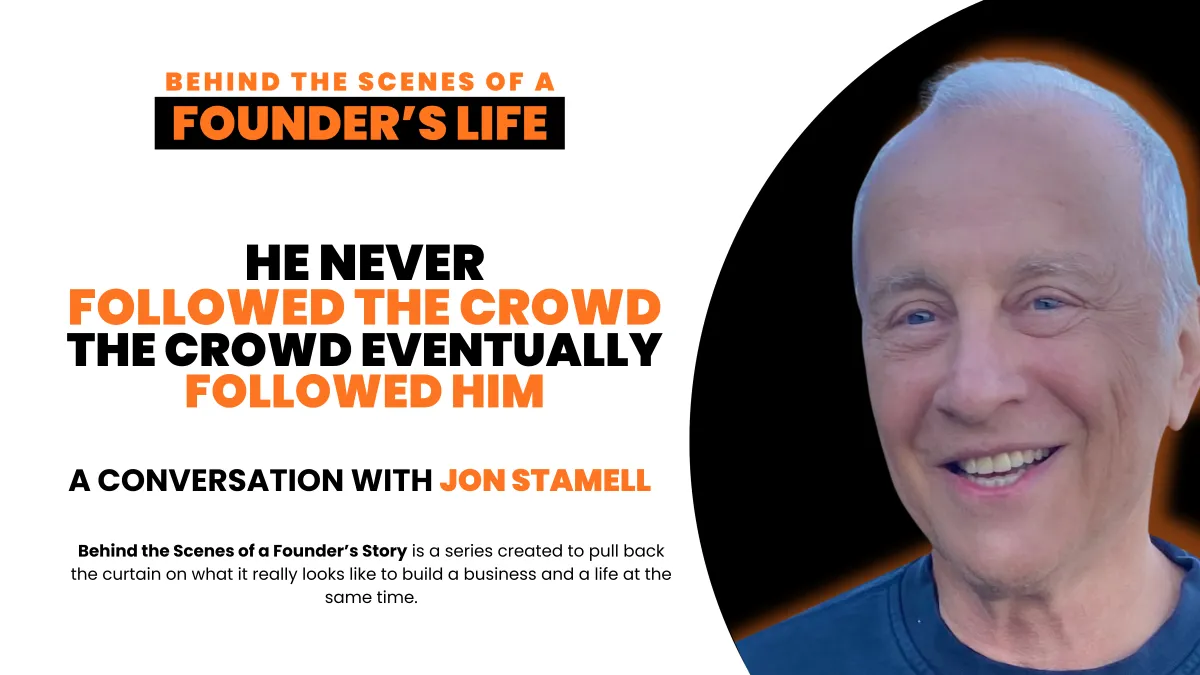
He Never Followed the Crowd. The Crowd Eventually Followed Him.
Behind the Scenes of a Founder's Life + Jon Stamell
I asked Jon Stamell to tell me about his journey as a founder.
He started by telling me about a personality trait he has carried his entire life.
Jon Stamell is the founder of Oomiji, a customer intelligence platform that helps brands learn who their customers really are. Not just their demographics, but their interests, needs, emotions, motivations, and perceptions, and then uses that knowledge to communicate with them in a way that actually resonates.
`But before Oomiji, there was an agency with 90 employees and around $60 million in billings. Before that, there was a strategy business. And before that, a trade show division he ran for a family-owned publishing and TV production company.
The through line across all of it is the same thing that has driven Jon since before he could name it.
A habit of going a different direction than everyone else.
Teaching Sailing in the Bahamas Was Not the Plan
His parents wanted him to go to medical school. When that did not work out, they pushed law school.
He came home in his senior year of college and told them he had a job.
"They said, what's your job? And I said, I'm teaching sailing in the Bahamas. They were just floored. They said we're not going to give you any money for that. I said, I don't need money. I've got a salary and room, and board. I figured it all out."
His friends majored in history, English, and economics. He majored in Far Eastern studies. His friends stayed close to the expected path. He kept looking for the other road. While his friends learned to play golf, he learned to race sailboats and participated in regattas throughout the Northeast, culminating in a TransAtlantic race, where in a storm, he was washed overboard, only to be saved by the good fortune of wearing a safety harness.
He went to graduate school after the Bahamas and his TransAtlantic foray. He has built multiple companies since. But that instinct, to look at where everyone else is going and quietly ask whether that is actually where he wants to go, has never left him.
"There's always been something about me that said, most people are going this way. What if I went that way?"
From Trade Shows to a 90-Person Agency
His first real window into business came through trade shows. He ran the trade show division for a family-owned company, and what he loved about it was the view it gave him.
"One of the great things about trade shows is that you can see across an entire industry. The buyers, the sellers, the government, media. Every element is there. It’s a really good way to learn about what is happening in an industry, what is new, what direction things are going."
But it was a family-owned company. There were limits to how far he could grow inside it. So after four years, he left and started what he thought would be a small strategy business.
It did not stay small. It became an agency. The agency grew to 90 employees and around $60 million in capitalized billings.
When he sold, he moved into consulting for CEOs and CMOs, advising agencies, and doing agency search work. And he carried with him an idea he had been turning over in his head for years.
That idea eventually became Oomiji.
The Idea He Could Not Let Go
Oomiji is a customer intelligence platform at Oomiji.ai. It gives brands a real understanding of who their customers are, what they want, and why they want it, and then uses that to drive smarter, more personal communication.
Jon developed the concept and hired software engineers to build it out. They incorporated around 2023. The pandemic slowed things down for a while, but the platform is running, and clients love it.
He described the problem it solves simply. Most brands think they know their customers. Most of the time, they do not.
"If you look at the way people answer questions or write, they first answer what they want to answer. They don't necessarily answer the question that's asked. And their thoughts are often jumbled and all over the place."
Understanding the real person behind the response, not a simulated version of them, not a demographic bucket, but an actual human with actual motivations, is what Oomiji is built to do.
They work across what Jon calls aspirational luxury. Wine and spirits. Skincare and beauty. Travel and tourism. Home and business accessories. Cultural organizations raising money. They have clients in the US, Europe, and South America.
The Biggest Early Challenge Was Credibility
I asked him about the hardest parts of starting out.
He said the same thing a lot of founders say, but with a specific angle.
"Very early when you go off on your own, credibility is one of the biggest issues. I did a lot of research into potential clients and their businesses, and then usually could get time with the CEO or CMO. And it's really a question of being a good listener and being very focused on what their needs are."
While now in New York, he had the advantage then of being based in Portland, Maine, a smaller community where relationships carried real weight. His network got him in the door. His listening kept him there.
The challenge with Oomiji has been a different kind. The market is crowded with platforms that claim to offer consumer engagement and customer insights. Standing out in that noise, while also staying specific enough to matter and broad enough to grow, is the ongoing work.
He has had meetings with VCs who told him the platform was unlike anything they had seen. But the investment has not come yet. So far, it has been friends and family funding, and he is building with what he has.
What Julia Child Taught Him About Listening
I asked him about the people who have shaped how he thinks.
He mentioned two. Both surprised me.
The first was Julia Child. He spent about four years doing television production work with her, and he told me something about her that I had never considered.
"She was the best market researcher I ever knew. People were always coming up to her saying they had all her books. And she would immediately turn that around and start asking them questions. What do you eat? Why do you eat that? What restaurants do you go to? Why? You do that thousands of times a year, you accumulate a tremendous amount of knowledge."
The second was a man named Ernesto Jobet, a Chilean naval admiral turned salmon industry executive whom Jon met while running Chile's global image campaign for a decade. The night of a coup, Jobet slept in his closet. He then became ambassador to New Zealand and the South Sea Islands.
"He was a survivor. Whatever obstacles were against him, he figured out a path either through or around them to have a very interesting and adventurous life."
Jon said both of them shared three things. Perseverance. Empathy for other people. And a good sense of humor.
He said those are his definition of success, too.
The Person Asking the Questions Is Always in Control
I asked him what lessons have shaped how he operates today.
He talked about hiring first. At his agency, they almost never hired anyone with a degree in advertising or public relations.
"We would hire philosophy majors, English literature majors, Asian studies majors. Something where people have been exposed to something different and they know how to think."
He told me the best interview he ever conducted was with a young woman who arrived with three pages of questions on a yellow pad. She got the job. She turned out to be a very good employee.
And then he said something that stuck with me.
"In any situation where you have two people, the person asking the questions is the one in control."
He has built his entire career around that idea. Asking better questions than anyone else in the room. Listening more carefully to the answers. And then using what he learned to do something with it.
That is what Oomiji is, at its core. A platform built on the belief that if you ask the right questions and actually listen to real people, you will understand them in a way that no simulation ever could. Today, they have clients in the U.S., UK, France, and Portugal. Jon doesn’t see any boundaries to what Oomiji can do.
What Is Next
I asked him what he is working toward right now.
He is moving Oomiji further into agentic AI. Building toward a platform where the thinking is done for the user, where the insights surface themselves, where brands do not have to interpret the data because the system does it for them.
"No one wants to think anymore. Being a creative problem solver has oftentimes been handed to AI, good or bad. That is the direction a lot of businesses have to take."
He said it with a touch of wry humor. Which felt right coming from someone who spent years watching Julia Child turn a fan encounter into a research session, and who once turned down law school to go teach sailing in the Bahamas.
He has always known that the most interesting path is rarely the obvious one.
He is still on it.
Want to Connect?
You can find Jon Stamell and learn more about Oomiji at Oomiji.ai. If you work in wine and spirits, skincare, travel, beauty, or any aspirational luxury category and want to understand your customers at a deeper level, reach out to him directly. You can also find him on LinkedIn, where he regularly shares insights on customer intelligence and brand strategy.
And if you are a founder with a story behind the scenes, I would love to hear from you too. These conversations remind us that success is rarely a straight line.
And if your challenge is execution, hiring, or freeing yourself from the day-to-day work, that is where we come in.
At Meet 5 Star Pros, we help founders hire high-level remote operators like Online Business Managers, Marketing Project Managers, and Executive Coordinators.
At Smart VAs, we provide dedicated virtual specialists who support marketing, operations, and growth so you can focus on what you do best.
Growth is not just about pushing harder.
It is about having the right people in the right seats.
And if you are a founder who wants to share your own behind-the-scenes story, DM me on LinkedIn.
Your story might be the one someone else needs to read today.
Sometimes growth is not about working harder.
It is about putting the right people in the right seats.
