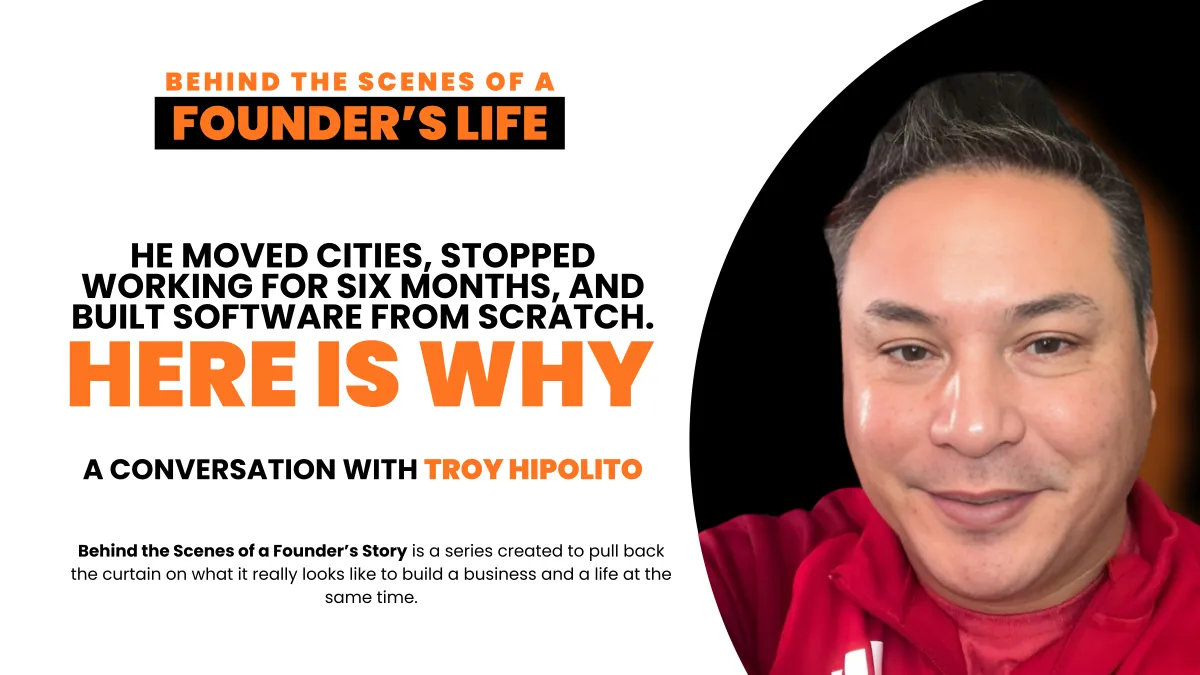
He Moved Cities, Took 6 Months Off, and Built Software From Scratch. Here’s Why
Behind the Scenes of a Founder's Life + Troy Hipolito
I asked Troy Hipolito to tell me about his journey as a founder.
He started with a story about slow dating.
Troy Hipolito is known on LinkedIn as “The Not-So-Boring LinkedIn Guy”. He helps B2B founders, consultants, and entrepreneurs build sales systems on LinkedIn that actually convert. He has 32,000 connections, a software product he built from scratch, and a philosophy about business that he has learned the hard way over many years.
But before any of that, there was a simple observation that drove everything.
Most people on LinkedIn are doing it completely wrong.
Stop Speed Dating. Start Slow Dating.
Troy noticed that most people trying to get business on LinkedIn make the same mistake. They connect with someone and immediately pitch them. They treat a first message like a marriage proposal.
"You just can't go to them and say, let's get married and have children. They're gonna slap you in the face."
He calls the right approach slow dating. You meet someone, you listen, you figure out if you are compatible, if you can be of genuine help to each other. You build trust before you ask for anything.
Most people skip all of that. They send a long message full of bullet points and credentials to someone who has never heard of them, wondering why nobody responds.
"No one reads stuff on LinkedIn. Direct messages is like a text. If it requires a lot, then maybe we should just talk about it."
So he built a system around slow dating for businesses. Clear messaging. A defined ideal client. Attracting the right people instead of talking to everyone and converting no one.
It worked. And then came the next challenge.
The Problem With Low Prices
Once he started getting clients, he ran into something a lot of consultants discover too late.
His prices were too low.
"We had $1,000 a month clients, and the vast majority of them needed $10,000 of work a month. It wasn't making sense."
Underpricing does not just hurt your revenue. It attracts the wrong clients, creates mismatched expectations, and burns through your time. He had to learn to charge what the work was actually worth and stop apologizing for it.
Now his banner on LinkedIn does the filtering for him. It says exactly what he does, who he does it for, and what level of business you need to be at to work with him. If someone reads it and disqualifies themselves, that is the point.
He also added a question to his booking link that he says reduced no-shows significantly. It is a simple yes or no.
"Yes, I have integrity. I will show up for the meeting. No, I do not have integrity. You should cancel the meeting."
He said some people get upset by it. Those are exactly the people he does not want to meet with.
He Stopped Working for Six Months to Build Software

The bigger pivot came when Troy decided he wanted what he called wake up money.
"There's consulting money, and then there's wake up money. Wake up money means you wake up and you're making money."
He had watched friends build software companies and generate serious income. He wanted to build something that worked while he slept, not just when he was on a call.
The problem was he did not have $150,000 to fund development.
So he made a sacrifice most people would not be willing to make. He moved from Atlanta to Las Vegas, cutting his cost of living down to a third. He lowered his client load. And for six months, he essentially stopped taking new work and poured everything into building the product.
"It was a major sacrifice. I just stopped working and built the software."
The product is called SKOOP. It is a LinkedIn tool that uses short personalized videos inside messages to dramatically increase response rates. One recruiter told him she sent videos to 21 people and got a 100 percent reply rate.
He just launched a redesigned version two days before we spoke. He already has 300 paid users and the software is covering half his monthly bills.
He is just getting started.
The Part Nobody Prepared Him For
Building the product was hard. Getting the market to care about it turned out to be harder.
He went to established software companies, thinking they would want to integrate his technology. What he found instead was a wall.
"I had one company say they love it and want the source code. I was born during the day but not yesterday. That means they're going to rob me."
Another company told him the product was great and they wanted to incorporate it into their platform, but they did not want to pay him anything for it. Another had their development team block the integration entirely.
He said the hard lesson was that companies already making money do not want to change anything, even if the change would make them more money. Comfort and control beat opportunity more often than people admit.
"You have to break into the market any way you can. So I used my network."
With 32,000 LinkedIn connections built over years of genuine relationship building, he had something most first-time software founders do not. An audience that already trusted him.
Being a Single Father While Building a Business
I asked him what one thing he wished he had in his business right now.
He talked about the software first. One or two large enterprise deals would change everything.
But then he said something more personal.
He is a single father. His daughter is nine. He does not have family nearby to help, and going out to network or grow his business in person is not always an option.
"As a single parent, I have to do what I can. That's why I built the software. It works, it makes money, and it converts really well, even when I can't be everywhere at once."
He said the sacrifice of building something this way is real. But so is the clarity it gives you about what matters.
"You have to really focus on what you're doing and ignore everyone else. Because as an entrepreneur, you're going to fail a lot sometimes. And people won't understand."
What He Has Learned About Giving Value First

I asked him about the lessons that have shaped how he operates today.
He talked about something he calls the three outcomes of helping someone for free.
The first is that they never talk badly about you. One bad client can take ten good ones to undo.
The second is that they try what you suggested, it works, and when they have a bigger problem later, you are the first person they call.
The third is that they cannot afford you or are not ready, but they know someone who is.
"If someone else says Kristy's the best and I trust that person, you have a much higher chance of working with that individual. So you want to put out goodwill. Help people where you can, as long as you're helping the right people."
That last part matters to him. Helping the wrong people burns your time in a way that is very hard to recover from.
What Is Next
I asked him what he is working toward right now.
He is building out the next version of SKOOP with a visual CRM component. Instead of rows of data that most people never look at, it will show you a visual map of who you need to follow up with, what is hot, and what needs to happen today.
"People don't use CRMs because they don't know what it all means. I think a visual component will be a real differentiator. If you're visually seeing what it is, you're shortcutting a lot of that process."
He is also adding email, text, and WhatsApp outreach, and plans to integrate with Go High Level, a platform widely used by freelancers and entrepreneurs.
He knows the path forward is volume. The software is low cost, which means he needs a lot of users, not a handful of big clients. He is building toward that, one relationship at a time.
Which, when you think about it, is exactly how he would tell you to do anything on LinkedIn.
Slow down. Build trust. Let the results come.
Want to Connect?
You can find Troy Hipolito on LinkedIn by searching Troy Hipolito. You can try his software SKOOP at skoopapp.com, where a free trial is available. If you want to see how it works, schedule a 20-minute setup call with him directly.
You can also take a look at his site at www.thetroyagency.com (he also has a booking link there).
And if you are a founder with a story behind the scenes, I would love to hear from you too. These conversations remind us that success is rarely a straight line.
And if your challenge is execution, hiring, or freeing yourself from the day-to-day work, that is where we come in.
At Meet 5 Star Pros, we help founders hire high-level remote operators like Online Business Managers, Marketing Project Managers, and Executive Coordinators.
At Smart VAs, we provide dedicated virtual specialists who support marketing, operations, and growth so you can focus on what you do best.
Growth is not just about pushing harder.
It is about having the right people in the right seats.
And if you are a founder who wants to share your own behind-the-scenes story, DM me on LinkedIn.
Your story might be the one someone else needs to read today.
Sometimes growth is not about working harder.
It is about putting the right people in the right seats.
