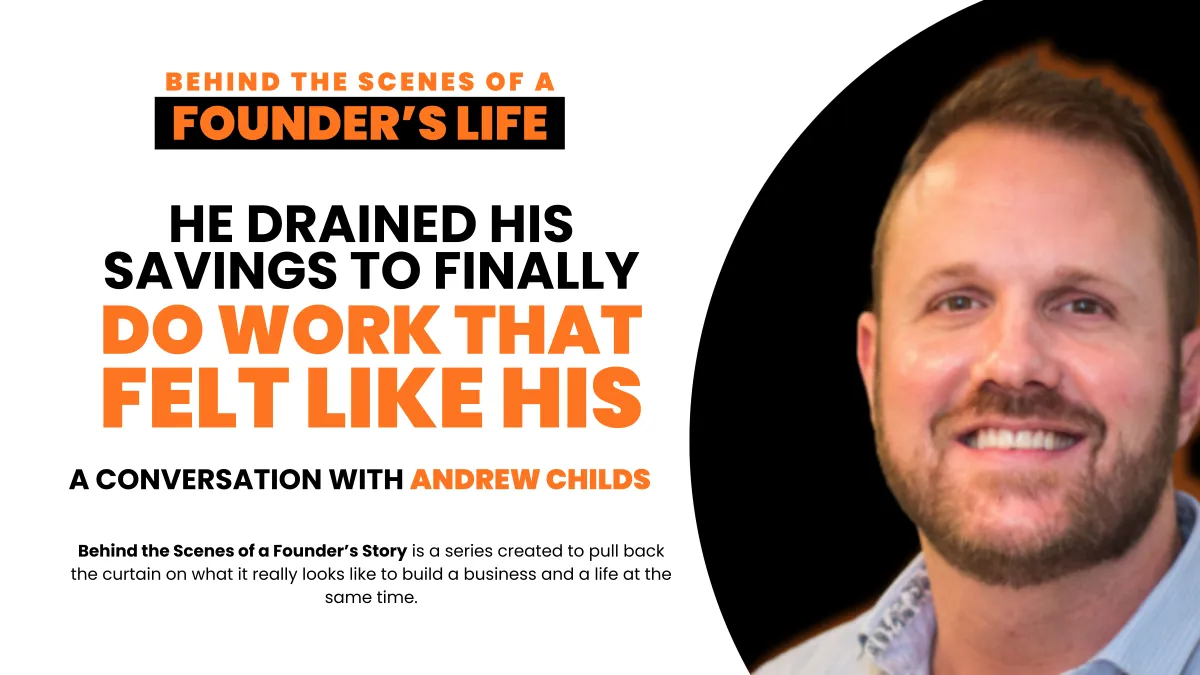
He Drained His Savings to Finally Do Work That Felt Like His
Behind the Scenes of a Founder's Life + Andrew Childs
I asked Andrew Childs to tell me about his journey as a founder.
He started with ten years in tech and ended up somewhere no job could have taken him.
Andrew Childs is the founder of Marcostrat, a branding and go-to-market agency he launched in 2025. He spent a decade in tech before making the leap, including four years at Amazon, stints at Expedia and Microsoft, and time at an AI startup.
At most of those places he was drawn to the smaller brands living inside the bigger ones. The scrappy teams figuring things out on the fly. The startup energy inside a corporate structure.
"I sort of liked that energy, that kind of pace. I like wearing multiple hats."
But there was always something missing. The work he loved most, building a brand from the inside out, connecting a product to a bigger story, creating a narrative that actually made something feel different in a crowded market, he could never do all of it in one place.
So he built the place himself.
Why He Could Not Stay
I asked him what made him finally decide to leave and start his own business.
He was honest about it.
"In my last role I was very limited to the kind of marketing I could do. It was all sales enablement, case studies, and pitch decks. Every time I tried to step out of that and do more brand work, my hand got slapped."
He knew what he wanted to do. Brand positioning. Content strategy. Go-to-market from the ground up, anchored in one central idea that everything else ladders up to. He had done pieces of it at Amazon and Expedia. He had never been able to do all of it.
The freedom to do the kind of work that gave him energy was the real reason he left. The freedom of schedule was secondary.
He incorporated in May of 2025. The website launched a few months after that. He poured his Amazon savings into getting it off the ground.
And he brought a partner with him. Magdalena Cisneros, a creative director he worked with at Amazon, leads the visual strategy and design side of the business. They are in it together.
Growing Up Around Small Business
I asked him if anything in his earlier years helped shape who he is as an entrepreneur today.
He thought about it for a moment.
"I come from a family where small businesses were the norm. My mom was in education, but her parents started a business that my dad ended up running as well. I saw the value and the joy it brought my dad. Also some of the challenges."
He described himself as someone who gets bored quickly when he is not being challenged. Someone who is always curious, always wanting to learn, always putting in his hardest effort when the stakes are high.
Starting a business was not on his radar ten years ago. But the further he got into his tech career, the more it started to make sense.
"I get to do something that's really challenging and it's always going to be that way because I'm trying to grow it. My curiosity is constantly satiated."
Personality and background pointed in the same direction. It just took a while for the timing to align.
The Hardest Part Has Been Finding Customers
I asked him about the challenges of building the business since launch.
He did not dress it up.
"To be honest, it's been very challenging. The hardest part has been acquiring customers."
He knows branding. He knows strategy. He knows how to take a product to market and tell its story in a way that makes it feel distinct. What he had never had to do in corporate America was cold outreach. Finding strangers and convincing them to pay him.
He has also wrestled with a tension that a lot of founders know well. How specific do you get with your audience before you start turning away work you could actually do? How general do you stay before you become impossible to remember?
"How focused do we get versus staying general enough to capture any business that comes our way? But we don't want to be too general because then I'm doing the kind of work I don't want to do."
He is still iterating on that. But he told me he is happier with where it sits today than at any point since launch. He has two audience segments taking shape. One tightly focused on B2B tech growth stage companies, where he can speak the language because he has lived it. The other a broader arm for founder-led small businesses looking to grow.
He recently hired an agency to run cold email outreach because he needed more leads in the pipeline. He is building the inbound engine on LinkedIn at the same time, knowing that is a slow burn with a long payoff.
The Lesson He Would Give to Anyone Starting Out
I asked him what lessons from his journey have shaped how he operates today.
He answered it the way he said he would, as advice to someone who was exactly where he was a year ago.
"Whatever first iteration of your business you have is probably not going to be the one you end up with. You will have to change, or be ready to change, more than you might anticipate."
He talked about perfection being the enemy of the good. About the cost of endlessly wordsmithing something instead of just getting it out into the world. A webpage. A pitch. A service offering.
"Sometimes you just have to launch something. It might be minimum viable quality. But there's a real cost to waiting indefinitely versus getting something out there."
He said the prerequisite for success is a willingness to change. Not once, but continuously.
What Has Actually Worked
I asked him what has worked since launching. Because challenges are worth talking about, but something has to be going right or he would not still be here.
His answer surprised me a little.
"Being really authentic about who I am as a person. In the beginning I was trying to be very executive, very buttoned up. And I lost sight of just being my authentic self."
He described himself as a little goofy. Someone who likes to joke. Someone who works best when there is a real human connection with the people he is working with.
When he tried to present himself as something more polished and corporate, the relationships were fine. But they were not the ones that felt good or lasted.
He said this connects directly to what he believes about branding for his clients. In a crowded market where products start to look similar, the thing that separates you is not a feature. It is what your brand actually stands for. What personality it has. What people feel when they interact with it.
"What I'm selling is an outcome, to build whatever your brand stands for, whatever you want that personality to be. Because that's what will differentiate you."
He lives that in how he shows up. And it is working better than the buttoned up version ever did.
What He Is Working Toward
I asked him what is next for the business and what he is working toward right now.
His answer was not about revenue targets or headcount or market share.
"I want to prove that I can do the work I say I can do and that my potential customers need. I’ve had some early wins, so I want to build on those. Ultimately, starting my own business is also about buying time for myself and my loved ones. I'm not super driven by money, but I am driven by not wanting to worry about it. I want a certain set of experiences that enrich my life."
He wants to travel with his spouse. To see his nieces in Florida more often. To spend more time with his parents as they get older.
He is working on a repeatable system. Refining his audience. Getting the acquisition channel running. Tightening the pitch.
Not to build a big company. To build a good life.
He told me he has gone through a lot of iterations since launching. And he feels like he is finally getting to a place where the method is becoming clear.
That is not a small thing.
A lot of founders never get there.
Want to Connect?
You can find Andrew Childs at marcostrat.com and on LinkedIn. If you are a founder-led business looking to build a clearer brand story and go-to-market strategy, reach out to him directly.
And if you are a founder with a story behind the scenes, I would love to hear from you too. These conversations remind us that success is rarely a straight line.
And if your challenge is execution, hiring, or freeing yourself from the day-to-day work, that is where we come in.
At Meet 5 Star Pros, we help founders hire high-level remote operators like Online Business Managers, Marketing Project Managers, and Executive Coordinators.
At Smart VAs, we provide dedicated virtual specialists who support marketing, operations, and growth so you can focus on what you do best.
Growth is not just about pushing harder.
It is about having the right people in the right seats.
And if you are a founder who wants to share your own behind-the-scenes story, DM me on LinkedIn.
